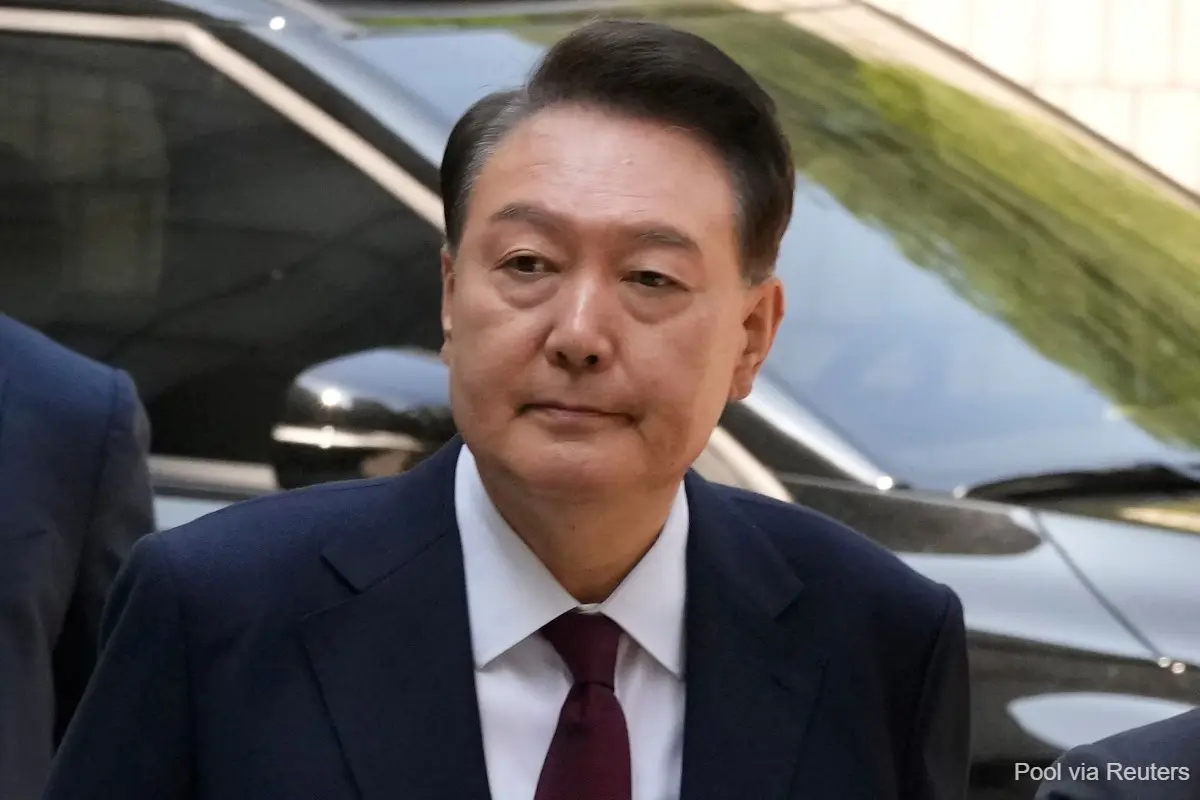
Former South Korean president Yoon Suk Yeol Friday sentenced to five years in prison in the first criminal ruling linked to his failed attempt to impose martial law.
A Seoul court found that he abused presidential authority to obstruct his arrest and bypass legal procedures, in a case that has tested South Korea’s democratic institutions.
The Seoul Central District Court found the 65 year old guilty of obstructing justice after he mobilised the presidential security service to prevent authorities from executing an arrest warrant issued as part of investigations into his martial law declaration.
In televised proceedings, the court also convicted the former prosecutor of fabricating official documents and failing to follow the legal procedures required for declaring martial law, which must be discussed at a formal cabinet meeting.
Reading the judgment, the lead judge said the former president had abused the authority of his office.
“The defendant abused his enormous influence as president to prevent the execution of legitimate warrants through officials from the Security Service, which effectively privatised officials, loyal to the Republic of Korea for personal safety and personal gain,” the judge said.
The ruling represents the first judgment among several criminal cases facing Yoon over a botched attempt to impose military rule.
Yoon listened quietly as the sentence was read out, showing no visible reaction in a courtroom packed with supporters.
Outside the court, one of his lawyers criticised the verdict and confirmed plans to challenge it. “We express regret that the decision was made in a politicised manner,” said Yoo Jung hwa, adding that an appeal would be filed.
Prosecutors declined to comment immediately on whether they would also appeal the sentence, a step permitted under South Korean law.
The obstruction charges stem from events in January last year, when Yoon barricaded himself inside his residential compound and ordered the presidential security service to block investigators seeking to arrest him.
He was eventually detained during a second operation involving more than 3,000 police officers, marking the first arrest of a sitting president in South Korea’s history.
Yoon is currently being held at the Seoul Detention Center on the outskirts of the capital. In a separate trial, prosecutors have sought the death penalty, accusing him of masterminding an insurrection by attempting to impose military rule without justification and suspend parliament.
Yoon has argued that declaring martial law was within his constitutional powers and said the move was intended to sound the alarm over obstruction of government by opposition parties.
Security was tight around the court complex during the hearing, with police deployed heavily in nearby streets only a few blocks from Yoon’s upscale Seoul apartment.
A small group of supporters gathered outside holding placards reading “History will be the judge” and insisting that Yoon “remained the president”.
His attempt to impose martial law lasted only about six hours before parliament, including members of his own conservative party, voted to overturn the decree.
Lawmakers later impeached him, suspending his powers, and in April last year the Constitutional Court removed him from office, ruling that he had violated his constitutional duties.
The episode sent shockwaves through South Korea, Asia’s fourth largest economy and a key United States security ally long viewed as one of the region’s most resilient democracies.
Yoon now joins a list of former South Korean leaders who have been convicted and imprisoned, a history that includes ex military ruler Chun Doo hwan, who was sentenced to death in 1996 for his role in a deadly crackdown on protests in Gwangju, a sentence later commuted.
The case is widely seen as another test of South Korea’s legal system and its willingness to hold even the most powerful figures accountable under the law.































Comments
Sign in with Google to comment, reply, and like comments.
Continue with Google